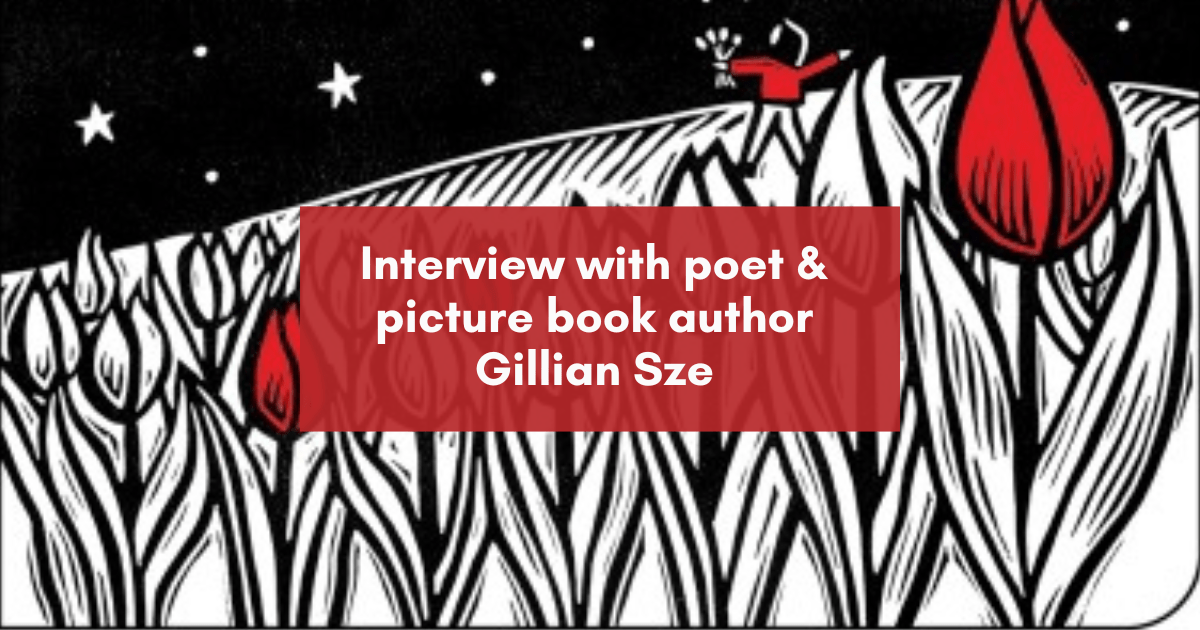
Hi there fellow kidlit creators! In this blog post, I’m re-sharing an interview with poet and Picture Book author, Gillian Sze. I first shared this interview back in 2021 on my former website when Gillian’s book, The Night Is Deep and Wide, illustrated by the wonderful illustrator Sue Todd, came out. This book is still one of my favourite board books, and Gillian has continued to create beautiful books for children. In this interview, Gillian shares her inspiration for the book, talks about her use of sound, rhythm, and her considerations when writing for children, and gives some great advice for newer picture book writers!
I hope you find the interview inspiring. Happy reading! Kim xo

Kim: Congratulations on your new board book, The Night Is Deep and Wide. Can you tell me a little about how the project came into being – did it start out as a villanelle?
Gillian Sze: Thank you, Kim! My idea for this book came from reading so many bedtime stories to my son. One night we came across one that reminded me of the villanelle. The text had a distinct rhyme pattern, repeated phrases, and—like most bedtime stories—it was short. I later scanned the lines of the book and realized that they didn’t fit the poetic form. It was then that I realized how perfect the villanelle is for housing a bedtime poem. The nineteen-line fixed form contains two refrains and two rhymes arranged throughout. As we’ve seen in Margaret Wise Brown’s Goodnight Moon, repetition is quite lulling. (“Goodnight” is repeated twenty times in thirty pages!) I provide further “layers” of repetition within the refrains: “row by row” as well as “close”; the word “close” refers both to the tulips closing and the reader’s eyes closing.
The villanelle determines the placement of these two rhyming refrains and the overall effect is something that feels circular, much like a full moon.
Kim: I love your handling of the villanelle form – the lines you repeat work perfectly throughout the poem, and the repetition of the ‘s’ sound and the rhythm works so well for a bedtime story book. How conscious are you of sound and rhythm when you write – do these elements come easily for you in your first/early drafts or would you say you focus on them more in your revisions?
Gillian: I appreciate your noticing the “s” sounds in the poem! This choice of sibilance in my early draft most likely derives from those many sleepy s-words we find in the English language: snooze, slumber, somnolence.
Your question reminds of what Mary Oliver says: “poets select words for their sound as well as their meaning—and that good poets make good initial selections.” She was talking about Robert Frost, a masterful poet who “worked from such a font of knowledge and sensitivity that often near-miracles of sound-and-sense have already happened.”
In my own practice, I am always conscious of sound and rhythm when composing in both open and closed forms. The sonic quality becomes even more important when working with a form that demands a particular arrangement of rhyme.
The greatest challenge when writing a villanelle is deciding on the refrains. In fact, when I teach the villanelle, I instruct my students to figure the refrains out first. What are two rhyming lines that can be heard again and again? What will our ears welcome? How do the meanings in those lines change as the poem progresses? How do the refrains affect the overall movement of the poem? For example, in Dylan Thomas’ “Do not go gentle into that good night,” readers get a sense that the poem brings the father figure (and us) closer and closer to that “sad height.” When Thomas repeats “Rage, rage against the dying of the light,” it’s not only an imperative, but the repetition of the line sounds increasingly desperate.
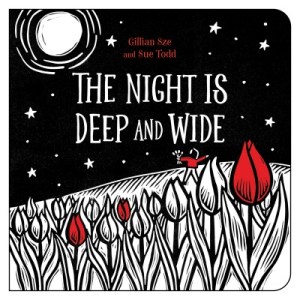
When choosing the refrains for The Night Is Deep and Wide, I wanted to settle on images that would encourage slumber for the young reader. I thought of the tulips that my mother planted behind our home. I remember those vivid evenings when the tulips would close up for the day, signalling sleep. The flowers serve as a small homage to my childhood and is (I hope) an image that refreshes the usual night imagery readers encounter in bedtime stories.
Kim: Are there any differences in the way you approach your poems that are destinated to be heard by children as opposed to those intended for an adult audience? What elements do you pay particular attention to in your poetry for children?
Gillian: I initially wrote this poem for my son, who was about two and a half at the time. He was my first audience and I hadn’t written for anybody that young before. My books up until then were poetry collections for older readers.
For this poem, I paid attention to my choice of imagery. I wanted to include things that he had encountered before. Our backyard receives many visitors: cardinals, blue jays, neighbourhood cats, squirrels, and even a groundhog who has found a home beneath our shed (and is probably gnawing away at its foundation).
I was also attentive to vocabulary. I wanted to use language that was accessible to both the infant listener (quite literally, those who cannot speak) and euphonious for the older reader. The word I struggled most with was “entices.” I had to stop and wonder if a child would interrupt the reading to ask its meaning. Could a parent provide a definition of the word quickly enough so as not to disrupt the poem’s flow? Could the meaning be clarified via illustrations or the surrounding poetic language? Moreover, does it matter if a child stops the reading to ask? Aren’t these questions of curiosity or clarity welcome interruptions? I decided to keep the word in the poem. And so the dark continues to “[entice] the tulips to close, row by row.”
Kim: What advice would you give to pre-published or emerging poets in terms of writing for children (and/or for newer poets in terms of improving their craft)?
Gillian: I share the same advice I received from my first creative writing instructor, David Bergen, with my students and anyone who wants to improve their craft: read. My shift from poetry to picture books only came about because, at the time, I was reading so many of them to my son. I don’t think my writing picture books could’ve happened any other way—I had to have been immersed. I didn’t even suspect that reading to him was, simultaneously, reading to me—all the while re-discovering and learning about the genre with each page flip.
Kim: Is there anything else you would like to share about The Night Is Deep and Wide or your other work?
Gillian: The final form that my poem takes is all thanks to editor Liz Kemp and illustrator Sue Todd. Liz and the team at Orca really believed in the poem as a board book. Liz also thought of the black-and-white approach, which Sue executes so spectacularly.
I am hoping that those who enjoy the poetry behind The Night Is Deep and Wide will also enjoy my forthcoming picture book, My Love for You Is Always (ill. Michelle Lee, pub. Philomel Books Sept. 2021). The book features a mother-child dialogue about love that centres on analogies with Chinese home-cooking.
About Gillian Sze:
Gillian Sze is the author of multiple poetry books, including Peeling Rambutan (Gaspereau Press, 2014), Redrafting Winter (BuschekBooks, 2015), Panicle (ECW Press, 2017), and Quiet Night Think (ECW Press, 2022), which were finalists for the QWF’s A.M. Klein Prize for Poetry. Her writing for children includes The Night Is Deep and Wide (illustrated by Sue Todd) and My Love for You Is Always (illustrated by Michelle Lee). Find out more about Gillian and her work at: www.gilliansze.com
To discover more about illustrator Sue Todd, visit her website: https://www.suetodd.com/
This interview was first published in 2021 on the RubyRiddlestein website (a former pen name of Kim T. Harrison).
 Kim T. Harrison