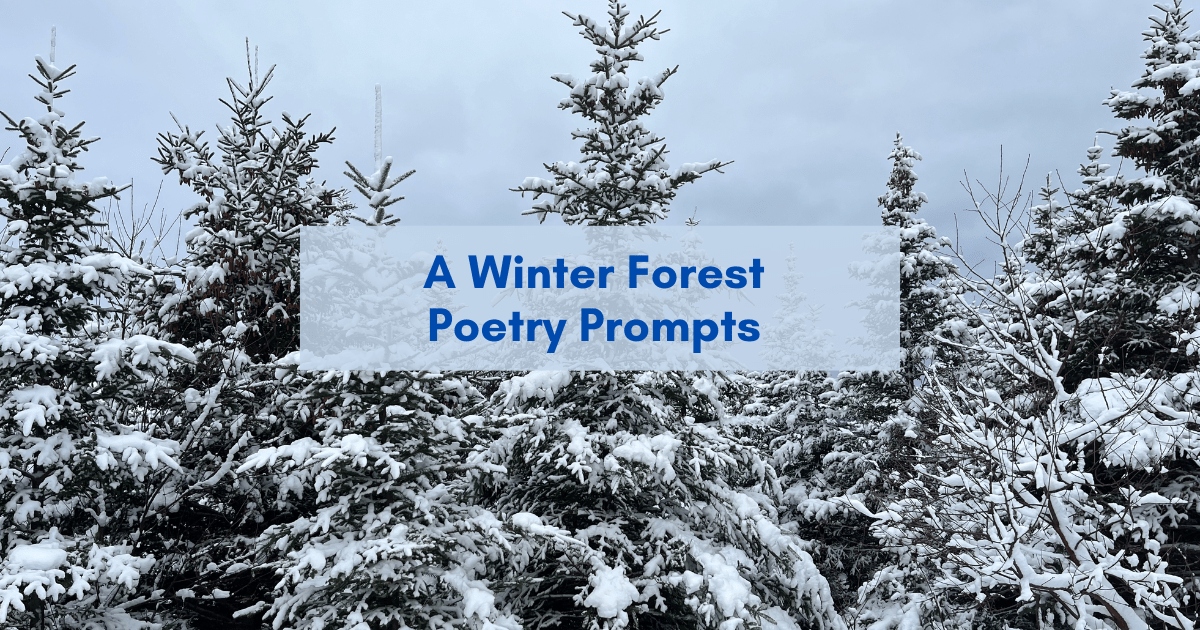
Winter Forest Poetry Prompts for KidLit Poets

Hey there fellow poets! Here are 3 new poetry prompts about “A Winter Forest.” Each has 3 “Ways to Play” ideas to inspire new poems or fresh perspectives on the prompt theme.

Let me know in the comments or via email if you write a poem from these prompts. I can’t wait to see what you create!

Listen to the prompts here:

Prompt 1

Write a poem about one or more animals who live in a winter forest.

Ways to Play:

  • Write the poem from the point of view of the animal. Crouch down (in your mind’s eye or in person) and see the forest from the animal’s viewpoint.
  • Bring in a narrative element – does your animal want something? What’s getting in their way and how do they overcome it? Can you tell a mini-story in poetic form?
  • Play with the form of the poem. For example, each stanza could be a different animal. Or, each stanza could focus on an element of the animal (physical appearance or personality).

Prompt 2

Write a poem about the sounds of a winter forest.

Ways to play:

  • Take a walk (in your mind’s eye or in person) through a forest and pause to listen. What do you hear? How can you capture those sounds in words?
  • Play with sound for this poem about sounds – include a tight rhyme or rhythm pattern. Repeat certain words or sounds. Don’t worry about narrative here. Make a fun poem that kids could dance or move to.
  • Create an extended metaphor poem inspired by one of the sounds you find.

Prompt 3

Write a poem about trees in a winter forest.

Ways to play:

  • Activate different senses for this poem. For example, what does a pine or spruce tree smell like? Are there other smells? What do pine needles or the bark of a birch tree look like? Spend some time really looking at them.
  • Put your science toque on and become a tree detective. How many types of trees are there in your forest? What are the common and scientific names? Are there any special characteristics? Play with the style of your poem. For example, write it in the style of an encyclopedia entry or scientist’s notebook. Or maybe your poem tells the story of a young scientist investigating trees.
  • Find the oldest tree in your winter forest. What has this tree seen and lived through? The highs and lows? How has the forest changed since they were a tiny sapling? Do they miss felled friends? Are they excited to see new growth? Tell this tree’s story in your poem.

Happy poetry writing, Kim x

Write Your Own Joy: 31 Poetry Prompts is out now in ebook and paperback formats. Read for free on Kindle Unlimited! For beginner or more experienced poets.

Receive occasional news, poetry and writing prompts, as well as resources to use at home or in the classroom by signing up to my free newsletter.
Winter Fun Poem, K-2

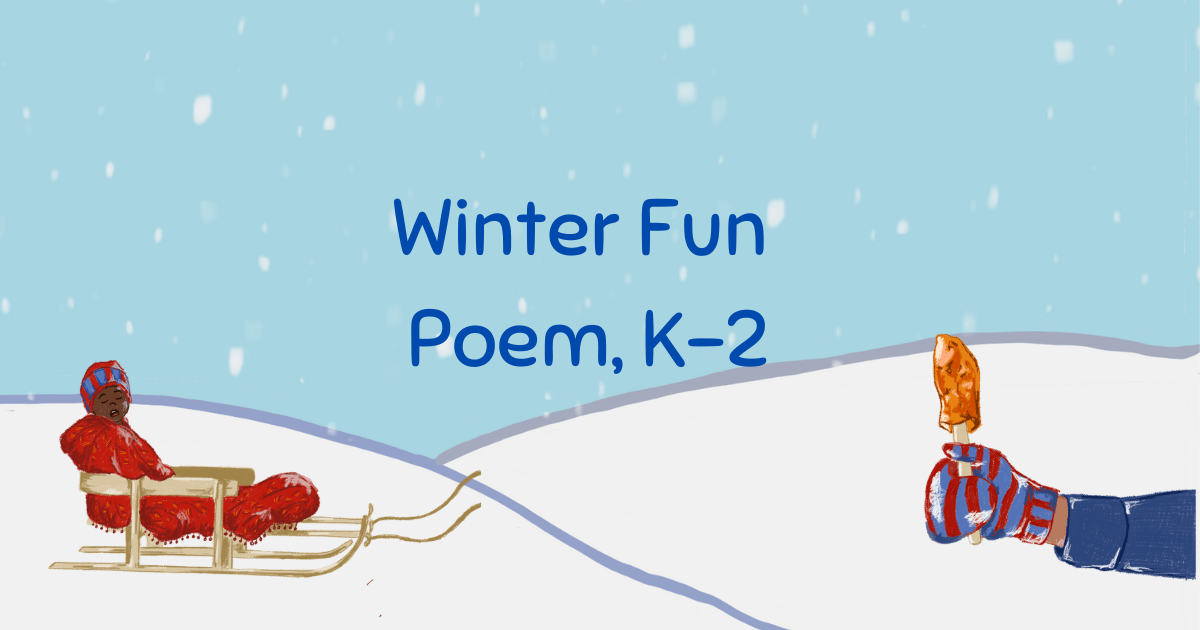
Hi fellow teachers! Here’s a fun poem for you to use in your Grades K-2 (ELL, grade 3; ESL, elementary) classrooms. I put some teaching ideas below to inspire you. Let me know if you use the poem – I’d love to hear how it goes.

Watch a video of the “Winter Fun” poem here:

Please pass me that carrot
To use as a nose
Now my snowman’s all done
From his head to his toes

Please pass me that shovel
To use for a door
Now my snow fort’s all done
From the roof to the floor

Please pass me that saucer
To use on the hill
Now my sledding’s all done
From the slide to the thrill

Please pass me that syrup
To use on the snow
Now my taffy’s all done
From the stick to the glow

Please pass me that blanket
To use on my sled
Now my day is all done
And I’m ready for bed

Teaching Ideas

Fluency practice:
Echo reading: read parts of the poem, or all the poem, out loud, one line at a time, and ask your students to repeat it after you
Performance reading/skits: ask students to act out or perform one of the stanzas
Pair reading: students read the poem to each other. Student A reads 2 lines, Student B reads 2 lines. They can switch for each stanza.

Retelling practice
Students retell the story using narrative structures. For example: First, they … Then, they… Finally, they …
Students change the poem into a prose passage using the SWBST formula: Somebody (the main character) Wanted (what did they want) But (Students can invent a problem) So (Students invent how the problem was solved) Then (Students say how the story ended). This can be done individually, in pairs, or as a whole group
Retell with pictures: Instead of writing, students use art to retell the story

Tie-ins
Good manners: Use the structure “Please pass me…” to practice asking for other things. Brainstorm other ways of asking for items politely
Rhyme: Ask students to find the rhymes in the poem. Brainstorm other words that rhyme (for example: nose, toes, bows, crows, …?)
Seasons: Can you build a snowman in winter? What can you do in winter where you live? Discussion or activities based on things to do in winter
Culture/Parts of Canada: Talk or learn about maple syrup in Quebec (sugar shacks – cabane à sucre, taffy – tire sur la neige)
Science: How do you make a snow fort? Students can create snow forts out of lego, blocks, or other materials. Explore questions such as: How long will a snow fort stay frozen? Do snowmen (or snow people) stay frozen for less time now than when our grandparents made them?
Art: Students illustrate the poem using drawing, collage, 3-D building, or other materials
Gym/Movement: Use the video on mute as the backdrop for a gym performance

Write Your Own Joy: 3 Poetry Prompts

Hey there fellow poets and writers. Are you ready to write some joy-filled poetry? Below are 3 prompts from my book Write Your Own Joy: 31 Poetry Prompts. Each prompt has “ways to play” suggestions below it – great for beginner poets looking for a little more structure or anyone wanting to try a different style or a new way into their poem. If you enjoy the prompts and want more, head over to Amazon for the ebook (read for free if you have KU) or paperback versions.

Sending you love and joy, Kim x

Prompt 1 (from Week 1, Day 2)

Write a poem about an item of clothing that feels special to you.

Ways to Play:

  • Think about the texture of the item: Is it hand-knit, chunky or fine, rough or supple? How can you describe that texture?
  • Where is the item from (store? hand-me-down? heirloom?) Is there anything special about how you came to have this item?
  • What feelings does this item evoke? Why is it special to you?

Prompt 2 (from Week 2, Day 11)

Write a poem containing these three words: beauty, towards, walk.

Ways to Play:

  • If you usually write free verse, try creating a simple rhyme scheme for yourself to follow today (for example: AA, BB, CC or ABA, CDC). Conversely, if you usually write in rhyme, try free verse or even a prose poem here.
  • Try creating a poem with three stanzas and use one of the words in each.
  • Or, use all the words in the first line of your poem.

Prompt 3 (from Week 4, Day 26)

Make an acrostic poem using the word POETRY as your base. An acrostic poem takes the base word and uses each letter as the first letter of each line.

For example:

Poems are fun
Or serious, or both
Each one a new moment
Transformed,
Retold, just for
You.

Ways to Play:

  • Make it a longer poem by either repeating the word POETRY three times or expanding the base word into a term: POETRY ROCKS; I LOVE POETRY; POETRY IS PERFECTION.
  • Instead of starting each line with the base word, end each line with the appropriate letter. (For example: the final word of the first line would end in a “p,” the final word of the second line would end in an “o,” and so on.)
  • Focus on one of the senses and explore its relationship to the word or idea of poetry. (For example: how does poetry sound? What does poetry look like on the page?)

Want more prompts? Get your copy of Write Your Own Joy: 31 Poetry Prompts on Amazon.

Read more about Write Your Own Joy here.

Find more free prompts on the For Writers & Poets section of my website.

Pen illustration: Farida Zaman

Write Your Own Joy: 31 Poetry Prompts is out now in ebook and paperback formats. Read for free on Kindle Unlimited! For beginner or more experienced poets.

Receive occasional news, poetry and writing prompts, as well as resources to use at home or in the classroom by signing up to my free newsletter.

#WriteWithJoy #PoetryPrompts #FindYourJoy #BeginnerPoets #CreativeWritingJourney #EverydayInspiration